Category: Opportunity Zones

Subscribe to Our Blog

July 29, 2019

The Value of Thoughtful Due Diligence with 1031 Exchanges and Opportunity Zone Investments

For investors considering a 1031 Exchange or Opportunity Zone (OZ) investment, thorough and thoughtful due diligence has probably never been more important than it is today. With 1031 Exchanges (and especially DSTs) along with OZ investments growing in popularity, the industry is seeing a lot of new offerings as well as new sponsors entering the space.  Read More
December 11, 2019

Qualified Opportunity Zone Fever?

As the end of the year approaches, Qualified Opportunity Zones (QOZs) remain one of the most hotly discussed topics in financial circles. This is in large part because to be eligible for the second tax step-up a QOZ investment affords in 2026, you need to be invested into a Qualified Opportunity Fund (QOF) by the end of 2019. Aside from the obvious timing implications, though, the underlying question still exists: are QOZs good investments? Here’s how we’ve responded to that question with our clients, many of whom have chosen to invest in QOFs we’ve suggested them to.  Read More
February 12, 2021

Large Stock Gains and Qualified Opportunity Zone Investing

While it wasn’t obvious at the time, it’s now clear that the COVID-19-induced sell-off this past spring created one of the best stock buying opportunities of our lifetime—the S&P 500 is up nearly 65% from the low and the Nasdaq is up roughly 80% over the same time. The tectonic shift in our economy also set some stocks skyrocketing; as of January 31, 2021, Zoom is up 235%, Moderna is up 712%, and Tesla is up nearly 1,000%!  Read More
April 14, 2020

IRS Announces Extended Exchange Deadline for Investors

Real estate investors who are selling property using a 1031 exchange received some welcome news last week! The IRS has issued new guidance extending the 45-day and 180-day deadline requirements currently defined in IRC section 1031. The notice stipulates that anyone with a 45-day identification period or 180-day closing deadline that occurs between April 1st and July 14th will have their deadline extended until July 15th.  Read More
July 08, 2019

A Brief Overview of Opportunity Zones

In 2017, the new federal tax law created Opportunity Zones with the goal of directing investment, development, and improvement in distressed communities around the United States. An Opportunity Zone is defined by the IRS as an economically-distressed community where new investments, under certain conditions, may be eligible for preferential tax treatment. As you may expect, Opportunity Zones are now, rightfully, getting a lot of attention.  Read More
October 10, 2025

Shifting Multifamily Supply / Demand Dynamics

Over the last several years, multifamily housing has experienced an unprecedented surge in new development. Fueled by strong demand, high occupancy, and historically low interest rates, developers pushed construction activity to levels not seen since the 1970s.1 Now that story is changing, and for property owners and investors, this shift points to a more favorable environment.

New Construction Starts Are Falling Nationwide

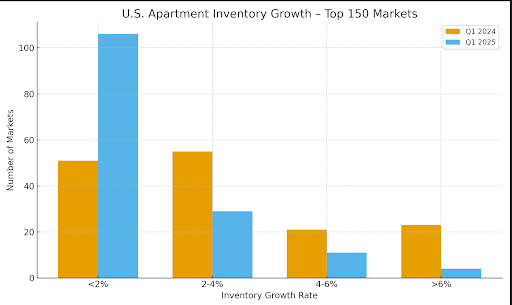
Across the top 150 U.S. markets, apartment inventory growth is retreating from historic highs. In 2023 and 2024, nearly one-third of markets grew supply by more than 4%. By 2025, that number is expected to drop considerably, with more than 100 markets seeing inventory expand by less than 2%—the lowest level since the aftermath of the Global Financial Crisis. This slowdown isn’t confined to one region. Sun Belt markets like Austin and Nashville saw outsized development in recent years and are now seeing supply expansion cut by nearly half. Gateway markets such as Boston are experiencing muted growth as well, with inventory projected to rise by just 2.6% in 2025.1
Demand Remains Resilient

Demand for rental housing remains historically strong, and there are a number of factors1 pointing towards this trend continuing:
  • The median first-time homebuyer is now 38, meaning households are renting longer
  • Vacancy rates remain below long-term averages
  • Absorption (net new renter households) has exceeded expectations in both 2024 and early 2025
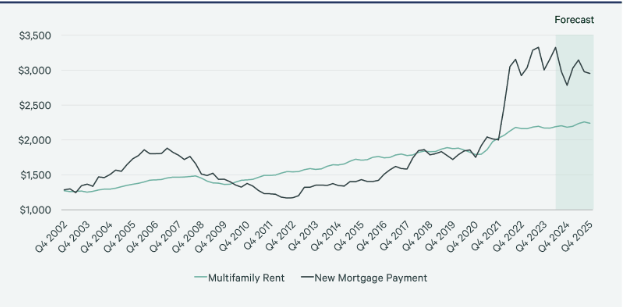
  • Mortgage rates have dropped from their peaks; however, the affordability gap between renting and home ownership remains historically large
Meanwhile, new deliveries are expected to fall dramatically. Between 2020-2024, the market delivered an average of 515,000 units per year. Forecasts over the next five years show new completions dropping to just 317,000 units annually.1
Future Outlook

This “supply cliff” sets the stage for a period where demand is likely to outpace supply, creating upward pressure on rents. Importantly, once this trend sets in, it will be difficult to slow down as multifamily development typically involves long timelines. On average, projects take around 29 months from permitting to completion.2

What This Means for Investors

For multifamily property owners, slowing supply and steady demand gains are creating an environment where rent growth is likely poised to accelerate. With fewer new units competing for tenants, owners may regain pricing power, improving both operating income and asset values. For investors considering 1031 exchanges or new acquisitions, the current market represents a potentially appealing entry point. As new supply continues to taper, the ability to capture rental growth could translate into attractive long-term returns. At Chicagoland 1031 Exchange, we believe these dynamics reinforce multifamily housing as a compelling hedge against inflation and a resilient income-producing asset class to diversify investors’ portfolios. We also continue to see multifamily investing as a cornerstone of 1031 exchangers' replacement property allocations. If you have any questions or want to learn more, we’re here to help. Talk to one of our advisors today. 1. CoStar, as cited in the Griffin Capital Market Research Note – Multifamily Supply Trends (July 31, 2025). 2. Griffin Capital  Read More
September 26, 2025

What the One Big Beautiful Bill Act Means for Commercial Real Estate Investors

On July 4, 2025, the “One Big Beautiful Bill Act” was signed into law, bringing a range of economic policy changes, including some that may affect commercial real estate investors.1

What’s Staying The Same

Notably, section 1031 remains largely unchanged. A 1031 exchange will still allow for tax deferral on the sale of real property by reinvesting the proceeds into new property. With the preservation of section 1031, we anticipate that, as real estate transaction volumes grow, so too will the demand for DST investments as replacement property. Section 721, which allows partners to contribute property to a partnership in exchange for operating units in the partnership, also remains unchanged. This is critical for potential exchangers who are considering DSTs that plan to undergo a 721 UPREIT transaction.

What’s Changing

The Qualified Opportunity Zone (QOZ) program that was originally introduced as part of the Tax and Jobs Act (2017) is being extended indefinitely. However, while the original rules remain in effect for now, several changes will be implemented beginning January 1, 2027, including:
  • QOZ maps will be redrawn. New zones can be designated every 10 years
  • The basis step-up provision is back. Under the original rules, investors’ basis would step-up by 10% after five years and 15% after seven years from when the program was instituted. The new legislation retains the 10% step-up after a 5-year hold
  • New step-up for rural investments. A new incentive has been introduced: a 30% basis step-up for investments held at least 5 years in Qualified Rural Opportunity Zones (QROZs)
  • Rolling five-year hold period. The required five-year hold period to receive the 10% step-up will now apply on a rolling basis
  • What qualifies as a Qualified Rural Opportunity Zone. QROZs will be defined as areas outside cities or towns with populations over 50,000, and not adjacent to urbanized areas

Final Thoughts

We view this bill as an overall win for commercial real estate investors. Preserving sections 1031 and 721 is crucial, as they will continue to be powerful tools for investors seeking to defer taxes related to the sale of real property. Importantly, indefinitely extending the opportunity zone program provides necessary clarity for the future of this powerful strategy. It will enable both fund sponsors and prospective investors to plan with greater confidence over a long time horizon. The addition of the QROZ 30% step-up could also prove beneficial. If you have questions about how this legislation might impact your portfolio, upcoming exchange, or QOZ investment, we’re here to help. Talk to one of our advisors today. 1. https://www.congress.gov/bill/119th-congress/house-bill/1/text  Read More
No, thank you.