Category: Insights

Subscribe to Our Blog

April 15, 2026

6 Reasons Why 1031 Exchanges are Worth Considering

When tax reform passed Congress last year, 1031 exchanges pertaining to real estate were spared major changes in legislation. This often under-looked yet tax-advantaged solution is potentially one of the most powerful tax planning and wealth preservation strategies available to investors.  Read More
June 27, 2024

The Rise of the Forever Renters

In December 2023, the Wall Street Journal published “The Rise of the Forever Renters.” The article examines a shift in housing preferences for people who could afford to purchase a home but are choosing to rent instead. Higher-end multifamily properties and built-to-rent properties have been preferred investment segments of the real estate market by many in recent years, and it appears this subcategory of real estate could still be one to watch as an investment opportunity moving forward. According to the article, between 2007 and 2022, the number of people living in rental housing in the U.S. increased by 15%, reaching 103 million. While high interest rates and a housing shortage are pushing some would-be homeowners toward renting, more and more people are simply choosing to rent. This change indicates a broader societal shift in housing across different age groups, driven by lifestyle preferences and financial constraints. The shift is particularly evident among younger professionals, with many expressing that it’s not a matter of affordability but a conscious choice based on perceived value. They prefer prime locations, convenience, and amenities of high-end rentals over the responsibilities and costs associated with homeownership. High-income earners are also increasingly choosing the rental lifestyle. In 2022, the number of renter households earning over $200,000 was four times higher than in 2010. Many older adults also prefer renting, highlighting the appeal of low-maintenance living and downsizing that rental properties offer. According to the Wall Street Journal, this increase in demand is resulting in strong property-level performance. The Heron building, a luxury apartment complex in Tampa FL, surpassed 95% occupancy seven months after opening. It also states that Built-to-rent communities designed to mimic the look and feel of traditional suburban living have occupancies exceeding 97% nationwide. Occupancy rates are only one of many important metrics to evaluate in a multifamily investment. At Chicagoland 1031 Exchange, we look at other data points including rent growth, lease renewals, loan terms, and local market performance to determine if an investment might be suitable for our clients. If you would like to learn more about luxury multifamily investments, and/or compare them to other types of real estate investments, contact our advisors today.
  1. Wall Street Journal
 Read More
March 03, 2026

DST Sales Surpass $8.4 Billion in 2025

Delaware Statutory Trust (DST) fundraising accelerated meaningfully in 2025, reflecting continued capital flows into passive real estate investment structures. This is also reflective of increasing commercial real estate transactions and investors continuing to look to defer taxes through 1031 exchanges, as a majority of DST investments are made in conjunction with a 1031 exchange. According to AltsWire and data compiled by Mountain Dell Consulting, total DST equity raised reached approximately $8.4 billion in 2025, up from roughly $5.6 billion in 2024. The 2025 figure narrowly missed hitting the high-water mark of 9.2 billion set in 2022.1 Momentum strengthened as the year progressed. December marked the highest monthly fundraising total of 2025, with approximately $862 million raised. Many expect that momentum to continue or perhaps accelerate through 2026 - if this happens, DST volume in 2026 could potentially surpass the 10 billion dollar mark. The data also showed that multiple established sponsors contributed meaningfully to total fundraising volume, with multifamily and industrial assets representing a significant share of offerings. While sponsor rankings shift annually, the broader pattern indicates steady platform participation and continued product availability across property types.

What This Means for Investors

The increase in DST fundraising suggests that investor demand for passive investment properties remains strong. It also indicates that the broader investment real estate market has increased transactions and that investors continue to value tax-deferral strategies such as 1031 exchanges. Strong capital flows into DSTs are likely representative of:
  • Liquidity and transaction volume in commercial real estate
  • Continued availability of quality DST replacement property options
  • Ongoing investor appetite for diversified, professionally managed assets
  • Aging investors looking for an off-ramp to active real estate ownership
As with any investment vehicle, structure and suitability depend on individual objectives. However, the 2025 data indicate that Delaware Statutory Trusts continue to play an active role in the 1031 exchange landscape. At Chicagoland 1031 Exchange, we help investors understand the 1031 exchange process. We know that everyone's situation is different, and we are here to help you understand the ins and outs of 1031 exchanges and DST investments. We continue to believe that meaningful client relationships, along with thoughtful and thorough due diligence, are the best way we can serve our clients. 1. Source: Altwire  Read More
October 10, 2025

Shifting Multifamily Supply / Demand Dynamics

Over the last several years, multifamily housing has experienced an unprecedented surge in new development. Fueled by strong demand, high occupancy, and historically low interest rates, developers pushed construction activity to levels not seen since the 1970s.1 Now that story is changing, and for property owners and investors, this shift points to a more favorable environment.

New Construction Starts Are Falling Nationwide

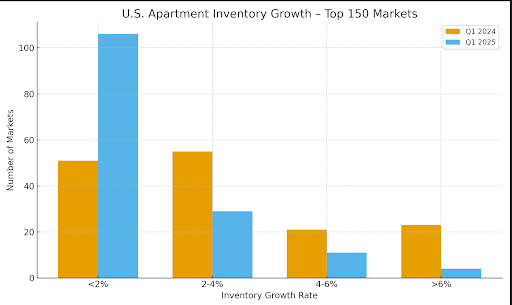
Across the top 150 U.S. markets, apartment inventory growth is retreating from historic highs. In 2023 and 2024, nearly one-third of markets grew supply by more than 4%. By 2025, that number is expected to drop considerably, with more than 100 markets seeing inventory expand by less than 2%—the lowest level since the aftermath of the Global Financial Crisis. This slowdown isn’t confined to one region. Sun Belt markets like Austin and Nashville saw outsized development in recent years and are now seeing supply expansion cut by nearly half. Gateway markets such as Boston are experiencing muted growth as well, with inventory projected to rise by just 2.6% in 2025.1
Demand Remains Resilient

Demand for rental housing remains historically strong, and there are a number of factors1 pointing towards this trend continuing:
  • The median first-time homebuyer is now 38, meaning households are renting longer
  • Vacancy rates remain below long-term averages
  • Absorption (net new renter households) has exceeded expectations in both 2024 and early 2025
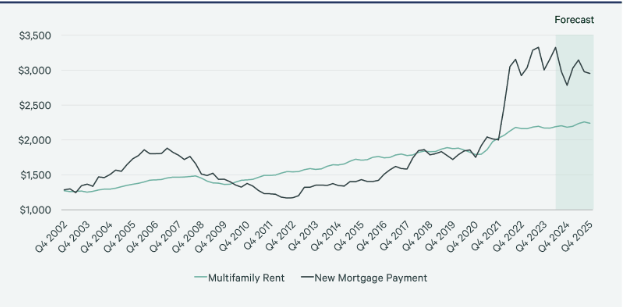
  • Mortgage rates have dropped from their peaks; however, the affordability gap between renting and home ownership remains historically large
Meanwhile, new deliveries are expected to fall dramatically. Between 2020-2024, the market delivered an average of 515,000 units per year. Forecasts over the next five years show new completions dropping to just 317,000 units annually.1

Future Outlook

This “supply cliff” sets the stage for a period where demand is likely to outpace supply, creating upward pressure on rents. Importantly, once this trend sets in, it will be difficult to slow down as multifamily development typically involves long timelines. On average, projects take around 29 months from permitting to completion.2

What This Means for Investors

For multifamily property owners, slowing supply and steady demand gains are creating an environment where rent growth is likely poised to accelerate. With fewer new units competing for tenants, owners may regain pricing power, improving both operating income and asset values. For investors considering 1031 exchanges or new acquisitions, the current market represents a potentially appealing entry point. As new supply continues to taper, the ability to capture rental growth could translate into attractive long-term returns. At Chicagoland 1031 Exchange, we believe these dynamics reinforce multifamily housing as a compelling hedge against inflation and a resilient income-producing asset class to diversify investors’ portfolios. We also continue to see multifamily investing as a cornerstone of 1031 exchangers' replacement property allocations. If you have any questions or want to learn more, we’re here to help. Talk to one of our advisors today. 1. CoStar, as cited in the Griffin Capital Market Research Note – Multifamily Supply Trends (July 31, 2025). 2. Griffin Capital  Read More
September 26, 2025

What the One Big Beautiful Bill Act Means for Commercial Real Estate Investors

On July 4, 2025, the “One Big Beautiful Bill Act” was signed into law, bringing a range of economic policy changes, including some that may affect commercial real estate investors.1

What’s Staying The Same

Notably, section 1031 remains largely unchanged. A 1031 exchange will still allow for tax deferral on the sale of real property by reinvesting the proceeds into new property. With the preservation of section 1031, we anticipate that, as real estate transaction volumes grow, so too will the demand for DST investments as replacement property. Section 721, which allows partners to contribute property to a partnership in exchange for operating units in the partnership, also remains unchanged. This is critical for potential exchangers who are considering DSTs that plan to undergo a 721 UPREIT transaction.

What’s Changing

The Qualified Opportunity Zone (QOZ) program that was originally introduced as part of the Tax and Jobs Act (2017) is being extended indefinitely. However, while the original rules remain in effect for now, several changes will be implemented beginning January 1, 2027, including:
  • QOZ maps will be redrawn. New zones can be designated every 10 years
  • The basis step-up provision is back. Under the original rules, investors’ basis would step-up by 10% after five years and 15% after seven years from when the program was instituted. The new legislation retains the 10% step-up after a 5-year hold
  • New step-up for rural investments. A new incentive has been introduced: a 30% basis step-up for investments held at least 5 years in Qualified Rural Opportunity Zones (QROZs)
  • Rolling five-year hold period. The required five-year hold period to receive the 10% step-up will now apply on a rolling basis
  • What qualifies as a Qualified Rural Opportunity Zone. QROZs will be defined as areas outside cities or towns with populations over 50,000, and not adjacent to urbanized areas

Final Thoughts

We view this bill as an overall win for commercial real estate investors. Preserving sections 1031 and 721 is crucial, as they will continue to be powerful tools for investors seeking to defer taxes related to the sale of real property. Importantly, indefinitely extending the opportunity zone program provides necessary clarity for the future of this powerful strategy. It will enable both fund sponsors and prospective investors to plan with greater confidence over a long time horizon. The addition of the QROZ 30% step-up could also prove beneficial. If you have questions about how this legislation might impact your portfolio, upcoming exchange, or QOZ investment, we’re here to help. Talk to one of our advisors today. 1. https://www.congress.gov/bill/119th-congress/house-bill/1/text  Read More
September 12, 2024

Rising Demand, Shrinking Supply, and Multi-Family Real Estate Investing

Affordable home ownership is under pressure for the average American. While there are many contributing factors, inventory shortages, along with high inflation that led to rapidly increasing interest rates, are chief among them. The country needs more housing units and new multifamily properties are one of the best solutions to provide that housing. The post-pandemic building boom in 2021 and the increase in millennials and Gen Z’s interest in multifamily living brought newly completed housing units to record highs in 2023 and 2024. These large buildings often have several hundred units and take about three years to complete from permit to certificate of occupancy. However, in the current environment, many developers are unwilling or unable to begin new projects. Banks have reduced the volume of lending due to lower deposits. Additionally, increased interest rates make new construction projects harder to finance. As a result, new construction “starts” are down about 40% year-over-year, according to Nick Rosenthal, Co-CEO of Griffin Capital, a major U.S. multifamily investment company. This marks the third straight quarterly annualized figure where starts have fallen by a similar amount. According to the Griffin Capital report, there were only 38,000 starts in the second quarter of 2024, which is the lowest figure since 2011. There is little sign of improvement with 12 of the top 50 major housing markets having zero starts in the second quarter of 2024.1 Accounting for this three-year lag between starts and deliveries, Griffin Capital is expecting the supply of new properties coming to market to bottom out in 2025 and into 2026. If this comes to fruition, newly completed properties will be at their lowest level in 10 years. The forecasted future lack of new supply means the supply-demand imbalance will be even higher than it is already. This long-term view of increasing demand for multi-family, coupled with the expectation of reduced supply coming to market, could be why some institutional investors are leaning into multi-family real estate investments. For 1031 exchange investors evaluating replacement property, or for accredited investors looking to diversify their portfolio, multifamily investments could potentially be a good choice. We continue to evaluate multi-family investment opportunities for our clients as both DST investments (primarily for 1031 exchange investors) and as funds (for cash investors). To learn more about Chicagoland 1031 Exchange’s take on the current real estate market, talk to one of our advisors today. 1. Email distributed by Nick Rosenthal, Co-CEO of Griffin Capital, August 2024  Read More
No, thank you.